A Premiere Night, Planned Around the Room
Premiere night planning starts with the room: map arrivals, introductions, sightlines, and audience flow to make the event feel composed, not congested.
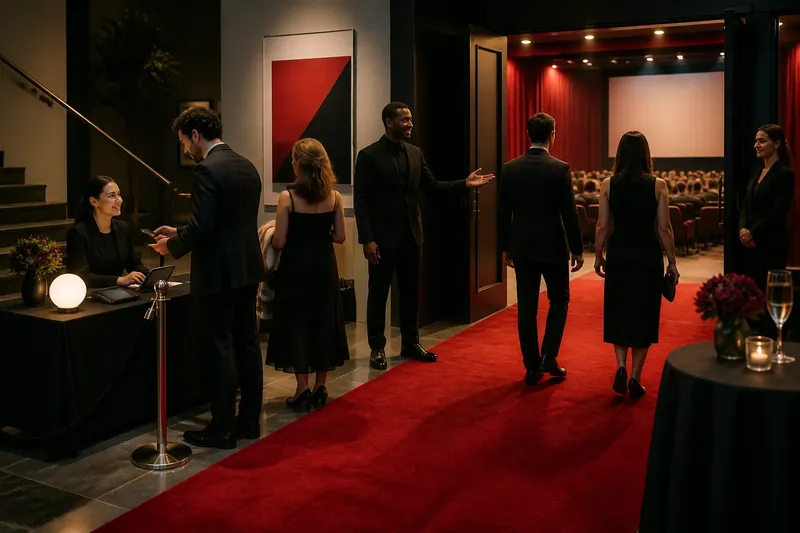
A premiere night becomes legible before the first welcome when guests can tell where to enter, whom to greet, and where to look. Good premiere night planning starts with the room itself: its doors, bottlenecks, sightlines, and pauses. The event’s schedule matters, but people experience it as a sequence of movements through a particular space.
These field notes focus on three moments that can quietly shape the evening: arrivals, introductions, and the movement of an audience between them. The aim is not to choreograph every gesture. It is to notice where the room invites confusion, then make a few deliberate choices that help guests feel oriented.
Where does the evening begin?
Guests begin forming an impression at the first threshold, not at the step-and-repeat or inside the screening room. Look at the approach from the street, lobby, or elevator. Can a newcomer identify the entrance without asking? Is there a visible welcome point before the first turn? A sign that can be read while walking is more useful than one hidden behind a queue.
Walk the guest route at an ordinary pace, carrying the sort of items a guest might have: a coat, a small bag, perhaps a drink. Notice what catches on the route. A registration table placed directly opposite a narrow doorway may turn a simple check-in into a knot of people. A photo backdrop positioned just beyond the entrance may cause arrivals to stop before others have cleared the door.
Draw the route on a floor plan, even if it is only a marked-up printout. Use arrows for movement and circles for places where people naturally pause: the check-in desk, a display, a bar, or a familiar face. Where arrows cross, consider whether one group can wait without blocking another. The aim is to see the room as guests will encounter it, not as a list of event stations.
Say you are planning a screening in a hotel ballroom with a lobby that opens onto a narrow passage. If the welcome desk sits inside that passage, arriving guests may stop there while others try to reach the ballroom. Moving the desk to a wider lobby wall and placing a greeter at the passage entrance could leave the route clear while giving late arrivals an obvious point of contact. That is a small spatial decision, but it changes the first few minutes for everyone behind it.
How should arrivals meet the room?
Arrival plans often focus on a single line: guests arrive, check in, and proceed. In practice, arrivals come in uneven clusters. A car may bring several people together; a guest may pause to greet someone; another may need help finding a name on a list. Make room for those variations instead of treating every delay as a scheduling failure.
Give the welcome team distinct, visible roles. One person can greet and direct; another can handle names or credentials; a third can answer questions away from the queue if the event has the staff for it. When one person has to perform all three tasks in the same spot, each conversation can hold up the next guest. A small table tent or unobtrusive badge can help guests recognize whom to approach.
Consider how different arrival groups will use the same entrance. Press, invited guests, cast and crew, and venue staff may need different routes or credentials, but separate lanes should not look like an unexplained hierarchy. Clear signs and a calm explanation can reduce the feeling that someone has taken a wrong turn. If a guest list is sensitive, keep it out of public sight and let staff confirm names discreetly.
Coats, bags, and refreshments also affect the threshold. A coat check can be convenient, but placing its queue beside registration makes two lines compete for the same patch of floor. A drinks station near the entrance may encourage people to stop where others are still trying to enter. Think about the sequence: where can guests pause after they have cleared the doorway, and where can they wait without blocking the next arrival?
What makes an introduction feel natural?
Introductions are easier when the room makes the next social move apparent. A host standing in the middle of a crowd can be difficult to locate; a host near a clear landmark gives guests somewhere to gather and a reason to move there. The landmark need not be elaborate. It might be a small stage, a reception table, or a recognizable display that does not obstruct circulation.
Decide which introductions need a microphone and which are better left to conversation. A formal welcome can gather attention, establish the evening’s sequence, and direct guests toward the screening. But a long string of names can turn an informal reception into a ceremony before the audience has settled. If several people need recognition, concise introductions and a visible cue about what happens next can keep the room attentive without making guests wonder whether they should keep standing.
For smaller groups, a host can help connect people who might otherwise remain at the edges. The useful skill is noticing who has arrived alone, who is already speaking with a colleague, and where a natural shared interest lies. An introduction should give both people a reason to continue talking, not simply transfer them from one conversation to another. Keep the host’s movement through the room open, so guests do not have to press through a tight cluster to reach them.
Photographs complicate these encounters because a camera can turn a greeting into a pause. If photography is part of the arrival, choose a location with enough room for a short stop and a clear way out. Tell guests where to continue afterward, or place a staff member beyond the camera area to guide them toward the reception. That handoff keeps a photo moment from becoming an accidental endpoint.
How can the audience move without losing the mood?
Audience flow includes more than the walk into the screening. Guests may move from a reception to a theater, from seats to a conversation afterward, or between a standing area and a presentation. Each transition benefits from a cue that is easy to notice: a brief announcement, a change in lighting, an usher at the relevant doorway, or a host moving toward the next space.
Keep the route to the screening distinct from routes used for service, equipment, or late arrivals where the venue layout allows it. A visible usher at a doorway can answer a question without making the entire audience stop. If guests must pass through a shared corridor, avoid placing a signing table, photo wall, or refreshment station along the narrowest part of it. The corridor is a route first; decorative activity should not turn it into a waiting room.
Think about what people need to see from where they are standing. At a reception, guests may try to hear a welcome while also watching for friends. If the speaker is hidden behind a display or positioned with their back to much of the room, listeners will shift and gather in the same limited space. A modest change in orientation can give more people a clear view and reduce the pressure to crowd forward.
Seating introduces another set of small decisions. Ushers should know which seats are reserved and which areas are open, but they should also be able to explain the arrangement without stopping the queue. If the screening includes introductions onstage, check that guests can see both the speaker and the screen from the seating areas intended for them. For accessibility needs, coordinate with the venue so the route, seating, and assistance match the specific space and the guests’ requirements.
Which room questions are worth settling early?
Should arrivals use one entrance or several?
Use the route that guests can identify most easily, unless the venue’s layout or the event’s access needs make another arrangement more suitable. If multiple entrances are necessary, give each a clear purpose and make sure staff can direct people who arrive at the wrong one.
Where should a photo backdrop go?
Place it where a small group can pause without blocking check-in, a doorway, or the route to the screening. Leave an obvious continuation path so guests can move on after the photograph rather than turning back into incoming foot traffic.
How should late guests be handled?
Choose a discreet waiting point and give an usher authority to guide guests in at a suitable pause. That keeps late arrivals from having to guess whether to enter while an introduction or screening moment is underway.
When should the host ask guests to move?
Use a cue that matches the room’s natural rhythm: after a welcome, when the screening doors open, or when the reception is clearly shifting to its next phase. A simple direction toward a visible destination is more helpful than an announcement that only says the program is continuing.
What should the final walk-through test?
A final walk-through is less about checking décor than about seeing whether the room’s decisions make sense in motion. Walk from the guest entrance to check-in, from check-in to the reception area, and from there to the screening. Then walk the same route in reverse, as a guest might when leaving. Notice whether signs remain visible, whether doors open freely, and where staff can stand without becoming obstacles.
Ask the venue contact to confirm practical details such as which doors will be open, where the house staff will be posted, and how the screening room will be entered. Venue procedures and access arrangements can vary, so align the plan with the location’s instructions and the needs of the guests. Keep a simple printed room plan with the event lead and the people directing arrivals; a phone screen may be difficult to consult in a crowded lobby.
Then stand in several likely guest positions. From the entrance, can someone see the welcome point? From the reception area, can they tell where the host is? From the back of the screening room, can they understand where to go afterward? These are not abstract design questions. They are quick checks against the ordinary uncertainty of entering a room where everyone else seems to know what is happening.
Premiere night planning is strongest when it treats movement as part of the welcome. A clear threshold, an introduction that gives people a place to gather, and a legible path onward can make the event feel composed without making it feel controlled. Before the doors open, spend a moment where the newest guest will stand. If the next move is apparent from there, the room is doing useful work.