When a Fan Theory Becomes a Claim
When a fan theory becomes a claim, separate what the story states, hints, and leaves to inference so discussion stays sharp without overstating evidence.
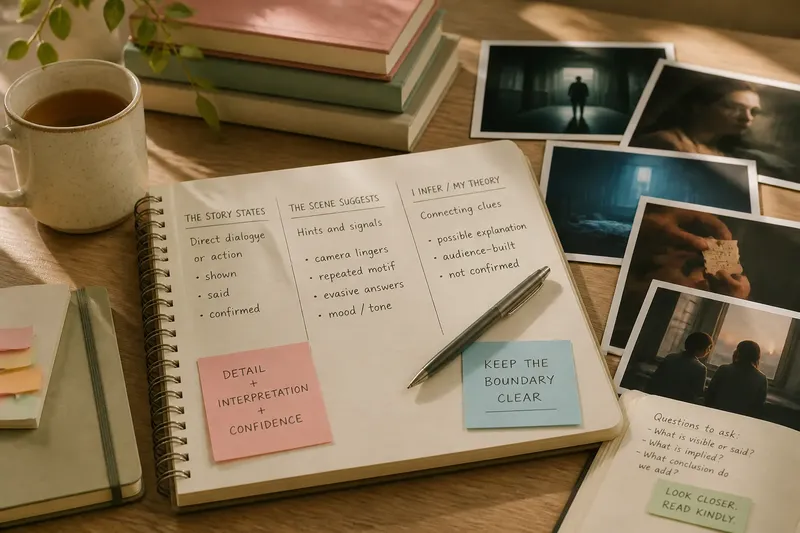
When a fan theory becomes a claim, a conversation can change in a single sentence: “I think the character planned it” becomes “The character planned it.” The distinction matters because stories invite interpretation, while claims about what happened ask other readers to accept a particular account of the evidence. You can keep both kinds of discussion lively by sorting observations according to what the work actually gives you.
This is a decision guide for three situations: a detail is stated outright, a pattern suggests something without confirming it, or a theory connects clues the story leaves open. The point is not to police how anyone enjoys a show, film, game, or novel. It is to make clear which part is on the page or screen and which part belongs to the audience.
What does the story state outright?
Start with what the work explicitly shows or says. A character announces a decision, a scene depicts an event, or a caption identifies a place. These are the strongest materials for a factual claim about the story, provided the scene is not contradicted or later reframed.
Even an explicit statement can have limits. A character may lie, misremember, or speak from incomplete knowledge. In that case, the fact you can safely report is that the character made the statement—not necessarily that the statement is true. A later reveal may change how the earlier line should be understood.
If you are discussing a direct detail, describe the observable evidence precisely. “Mara says she hid the key in the greenhouse” reports dialogue. “Mara hid the key in the greenhouse” treats her words as confirmed events. The second version may be reasonable if the story corroborates it, but without corroboration it goes further.
Use this category when you want to correct a clear misdescription or anchor a discussion in a scene everyone can locate. Mention the episode, chapter, or scene when useful, and distinguish a character’s account from the work’s confirmation. That precision leaves room for later context without making a firm detail sound vague.
What fits when the story only hints?
A hint is an observable detail that points toward an interpretation without settling it. A camera lingers on a cracked photograph; a character avoids a question; a melody returns when two people meet. Such choices can be meaningful, but they do not, by themselves, establish a single explanation.
When you see this kind of signal, use language that preserves its uncertainty: “The scene suggests,” “That may point to,” or “I read this as.” Then name the detail behind the reading. This is more useful than calling a moment “proof,” because other viewers can inspect the same scene and explain why they read the signal differently.
Hints can accumulate. A repeated color, an oddly specific phrase, and a reaction shot may make one interpretation feel increasingly persuasive. Still, a cluster of suggestive details is not automatically confirmation. Ask whether the story has ruled out other explanations, or whether the pattern could serve mood, characterization, misdirection, or several purposes at once.
Choose this category when the story appears to guide attention but keeps the conclusion open. It lets you make a strong reading without pretending the creators have supplied a verdict. “The recurring blue light makes me suspect the room is connected to the character’s memory” is a clear interpretation; “The blue light proves the room is a memory” is a stronger claim than the detail alone can bear.
When is it an inference rather than evidence?
An inference joins details to reach an explanation the story has not directly confirmed. It may be elegant, emotionally resonant, and well supported. It is still an audience-built account, not a stated fact, unless the work later adopts it.
Say you notice that a detective keeps a torn ticket, appears near a locked theater, and changes the subject whenever the missing singer is mentioned. You might infer that the detective knows where the singer went. If the story never confirms that connection, the careful version is “My theory is that the detective is hiding knowledge,” followed by the clues you are connecting. The expected result is a discussion about the interpretation and its evidence, not a misleading report that the reveal already happened.
Inference is not a lesser form of fandom. It is often where close attention becomes enjoyable: readers build possible explanations, compare them, and revise them as new scenes arrive. The useful boundary is simply to label the bridge between the details and the conclusion. A theory can be compelling without becoming canon.
- Use “the story states” for direct, unambiguous dialogue or action.
- Use “the scene suggests” for a signal that supports a reading but does not settle it.
- Use “I infer” or “my theory is” when you connect clues into an explanation.
- Use “the work confirms” only when the story itself supplies confirmation, not merely because a theory fits.
How should you phrase a reading without overselling it?
Give readers three things: the detail, your interpretation, and the degree of confidence the story allows. This structure is brief but generous. It lets someone disagree with your conclusion while still understanding what prompted it.
For instance: “In the final scene, the caretaker turns the portrait toward the wall; I read that as guilt, though the scene does not explain the gesture.” The first part identifies an observable action, the second names the interpretation, and the last keeps the unanswered question visible. Compare that with “The caretaker is guilty,” which removes the distinction and invites a dispute over a fact the story may never establish.
Confidence should track the evidence, not the number of people repeating a theory. A popular interpretation can remain an inference, while a small detail stated clearly in the story can be a fact. If a discussion is getting heated, return to the scene itself: what is visible or said, what is implied, and what conclusion does the audience add?
Which wording fits your situation?
What if a character says something directly?
Report the statement as dialogue or as that character’s account. Call the underlying event confirmed only if the story gives you reason to treat the character as reliable or provides corroboration.
What if several clues point in the same direction?
Describe the clues and say that they support or strengthen your reading. Unless the story closes off other explanations, keep the conclusion framed as a theory rather than a settled event.
What if a later episode changes the meaning?
Update the claim and explain what new information changed your interpretation. An earlier reading can have been reasonable at the time without remaining the best account after the reveal.
What if fans disagree about what counts as canon?
Separate the scene everyone can check from the conclusion each person draws, and identify which version of the work or continuity you mean. Some franchises keep multiple versions in circulation, so a detail may be canon in one account and absent from another.
Why does this distinction improve fandom discussion?
Clear labels make disagreement more productive. Someone can challenge the inference, offer another explanation for a hint, or point out that a line was a character’s claim rather than an objective account. The conversation stays focused on interpretation instead of turning every difference into an accusation that someone has ignored the story.
It also helps fans welcome uncertainty. Some works deliberately leave motives unresolved; others reward a theory later, then complicate it again. Treating every plausible reading as confirmed can flatten that design. Naming what remains unknown allows the story to keep its ambiguity while still giving fans room to reason together.
When a fan theory becomes a claim, the repair is often small: change “this proves” to “this suggests,” or “that happened” to “I think that happened.” Then point to the scene. Those few words make the boundary between evidence and imagination visible—and keep a good theory open to the next piece of the story.