The Press Kit as a Carefully Edited Introduction
A press kit introduces a production to journalists; learn what its materials clarify, what they frame selectively, and how to read both with care.
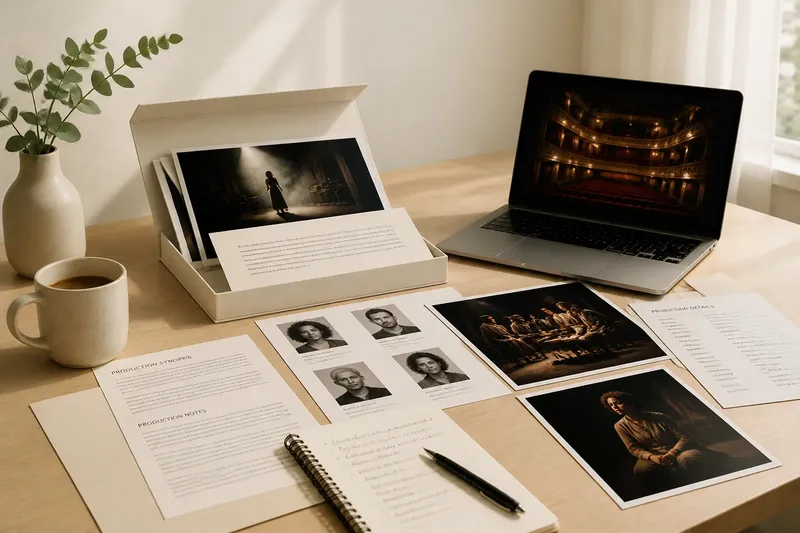
A press kit introduces a production to journalists, but it also shows what the production wants noticed. For a reporter on deadline, its synopsis, biographies, photographs, and production notes can provide useful starting points—so long as their framing is not mistaken for the whole story.
These seven features can help you use a press kit’s material while keeping its limits in view.
1. Start with the synopsis, then ask what it leaves out
A synopsis should help a reader understand the premise, the principal characters, and the kind of experience the production offers. It is often the quickest way to decide whether a story fits a publication’s audience. A concise account can be genuinely helpful, especially when a journalist is unfamiliar with the material.
But a synopsis is not a neutral map. It may emphasize a romance, a mystery, or a social theme while avoiding details that the publicity team considers spoilers or distractions. Its omissions do not automatically reveal a hidden agenda; they do show where the kit draws a boundary around what it considers appropriate to disclose.
For coverage, separate what the synopsis states from what it implies. If it calls a story a “family drama,” for example, that label is the production’s description. It does not settle how the work handles family conflict, whose perspective it centers, or whether the tone supports the label. Those are questions for the production itself and for the journalist’s own viewing or reporting.
2. Read biographies as credentials, not character analysis
Cast and creative-team biographies establish who made the production and highlight experience the publicity team considers relevant. They may mention prior stage work, screen roles, awards, training, or a particular artistic specialty. These details can help a journalist prepare informed questions and identify people whose backgrounds connect to the work.
Biographies are also selective. A short entry cannot represent a whole career, and its chosen credits do not establish what a performer contributes in the current role. Watch for the difference between a verifiable credit and an evaluative phrase such as “beloved star” or “visionary director.” The credit is a lead to check; the adjective is promotional language.
When a biography omits a detail relevant to the story, that omission is a reason to ask, not a license to speculate. A journalist can request clarification, seek an independent account, or leave the detail out if it cannot be substantiated. The press kit supplies an introduction to its contributors, not a complete profile of them.
3. Treat production notes as a statement of intent
Production notes can explain why a project was developed, how its creative team describes the central idea, and which themes the team hopes audiences will notice. This material is particularly useful when a production involves unfamiliar terminology, a specific adaptation, or a creative choice that would be hard to infer from a short synopsis.
Intent, however, is not the same as effect. A note may say the work aims to challenge an assumption or honor a community; the journalist still needs to consider what appears on stage or screen and whose account is represented. The notes explain how the creators want the work understood. They do not settle how it functions or how audiences will receive it.
Use the notes as an interview map. A claim about a production’s origins can prompt a question about the decisions behind it. A stated theme can lead to a question about where that theme appears in the work. This preserves the notes’ value while giving the journalist room to examine the choices rather than echo the language.
4. Notice which images carry the introduction
Press photos do more than illustrate a story. A selected image can establish the visual mood, foreground a performer, suggest a relationship, or make the production look intimate, extravagant, comic, or severe. Captions and credits also matter: they identify people, clarify context, and tell an editor how the image may be used.
A small set of approved images may be chosen for clarity and consistent promotion, not to show the full range of the production. An image can capture a striking pose without revealing the scene around it. A portrait can make a single actor appear to be the obvious center of an ensemble work. Editors should consider whether the image supports the article’s actual focus rather than merely matching the kit’s preferred impression.
Imagine a journalist covering a play whose kit includes a polished portrait of its lead but no ensemble photograph. The portrait may be useful for a profile, while a story about the company’s collaborative process would need a different image or a request for additional material. That choice does not accuse the publicity team of hiding anything; it matches the illustration to the reporting.
5. Check the practical details before repeating them
A kit may list a performance venue, run dates, ticket information, production credits, a press contact, or a publication window for images. These details are operational rather than interpretive, but an error can still confuse readers or create trouble for an editor. Treat each item as something to verify before it appears in print or online.
- Check the production title and the spelling of names against the latest official material; if they match, use those forms, and if they conflict, ask the production’s press contact to confirm them before publication.
- Check the venue and schedule with the presenting organization; if its current information matches the kit, use it, and if it differs, hold the service details until the organization clarifies them.
- Check each image’s caption, photographer credit, and permitted use; if all are clear, pair the image with its correct credit, and if any are missing or ambiguous, request clarification or choose another image.
- Check whether the listed contact handles press inquiries, ticketing, or another purpose; if the role fits your question, contact that person, and if not, ask for the appropriate contact instead.
- Check whether a quoted description comes from a named creator, an organization, or the publicity team; if the source is identified, attribute it accurately, and if it is not, avoid presenting it as a direct quote until its origin is confirmed.
- Check any publication restriction against the current agreement or source instructions; if the terms are clear, follow them, and if they are unclear or conflict with an older attachment, ask the responsible source before using the material.
Small distinctions carry meaning. A production credit can identify who shaped the work; a ticket link directs readers to a service; a publication restriction can affect when material may appear. If a detail depends on a current policy or agreement, clarify it with the source responsible rather than relying on an old attachment or copied text.
6. Keep the kit’s story separate from the article’s story
A press kit is designed to make a production legible and appealing. That goal can produce useful context, clear credits, and access to people who can speak about the work. It can also narrow attention toward the themes, images, and participants the publicity team has chosen to foreground. The journalist’s task is not to reject that selection automatically, but to see it as a selection.
Say you are assigned to cover an invented touring play called Harbor Light. Its press kit describes it as a family drama, supplies a biography for its lead, and includes only a solo portrait. First, you record the “family drama” phrase as the production’s framing rather than your own assessment. Next, you check the lead’s listed credits against an independent source and ask the press contact for an ensemble image. Then you view the play and interview a creator about how the family conflict is staged. If the material supports a story about the lead’s role, the portrait may fit; if your reporting centers the company’s shared process, the requested ensemble image is the better match. The resulting article can distinguish the production’s intended introduction from what your reporting actually establishes.
What should journalists ask about a press kit?
What belongs in a production press kit?
Common materials include a synopsis, biographies, production notes, images, credits, and contact information. The exact mix varies, so a journalist can request missing material that is relevant to the story.
Is a press kit an independent source?
No; it is prepared or distributed by an interested organization and should be attributed accordingly. Its factual details can still be useful, but important claims need confirmation from suitable sources.
How should a journalist use publicity quotes?
Identify who said the words and where they appeared before quoting them. Promotional copy should not be presented as independent criticism or as a reported reaction from an audience.
What if the kit conflicts with another source?
Pause before choosing either version, then ask the relevant parties for clarification and consult authoritative records where appropriate. If the discrepancy cannot be resolved, describe it carefully or omit the disputed detail.
Use a press kit as a starting point with clear edges. Its biographies, notes, images, and practical details can save time and open useful lines of inquiry, provided each is understood for what it is. That is the value of reading a press kit carefully: it can inform your coverage without dictating what the article becomes.