Live or Recorded: What Changes in a Performance?
Live or recorded performance calls for different rehearsal choices. Learn how to adapt blocking, timing, sound, and continuity without losing the scene’s intent.
Live or recorded performance asks a practical question before the first rehearsal: what must change when a scene moves from a shared room to a production workflow? The answer is not simply “more” for the stage or “less” for the camera. Each format gives performers different constraints around cues, equipment, and the way a moment is assembled.
Start with the task the production needs the performance to do. A stage scene has to proceed through its sequence in real time; recorded material may be shaped through takes, coverage, and editing. Those conditions affect preparation, but they do not require a performer to replace the scene’s central intention.
What does the production ask you to deliver?
Before changing a choice, clarify the production’s plan. A theater performance may involve a fixed sequence, live music, scene changes, or cues shared with stage management. A screen production may schedule scenes out of story order, record several versions of a moment, or capture separate shots that will later be joined.
Ask the director or stage manager how the work will run, which cues are fixed, and where performers have room to adjust. For recorded work, clarify the scene’s shot plan and who will track continuity. These questions keep a performer from solving a production issue with an acting choice that conflicts with the wider plan.
How do blocking and cues differ?
Onstage, blocking must remain workable across the full playing area and in relation to entrances, exits, scenery, and other performers. A movement may need to clear a doorway or land in a place where a partner can deliver the next cue. Mark those practical anchors during rehearsal, while keeping the movement motivated by the scene.
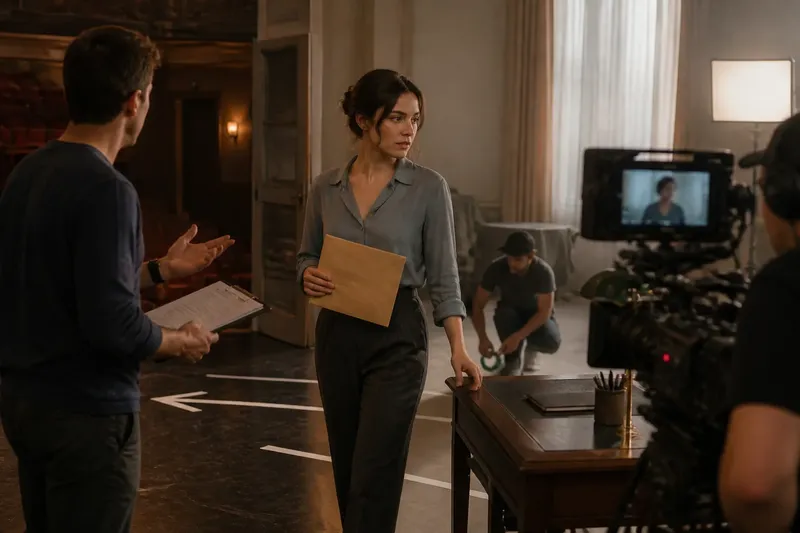
Recorded blocking is often coordinated with the camera, lighting, sound, and the position of other performers. A mark on the floor may show where to stop so the shot remains usable. Treat that mark as a production boundary, not as a reason to look down or break the action; rehearse a natural path into it and confirm the intended eyeline.
Say you are playing a conversation that begins beside a table and ends at a doorway. For a stage version, you might keep the route clear of a set change and agree on the doorway cue with stage management. For a recorded version, you might pause at a floor mark near the door so the camera can hold the planned frame. The observable result is a sequence that stays playable in the room or usable in the shot without changing why the character moves.
What should you clarify before rehearsal?
- Sequence: Check whether scenes run in story order; if they do not, mark the emotional and physical starting point for each scheduled scene, or ask the director for a transition note.
- Cues: Check which words, sounds, or movements trigger the next event; if a cue is fixed, rehearse it consistently, or confirm who can authorize an adjustment.
- Blocking: Check entrances, exits, marks, and furniture paths; if a route conflicts with a camera or set change, agree on a new path before repeating it.
- Sound: Check whether microphones, live instruments, or playback affect movement and speech; if equipment restricts an action, ask the sound team for an approved alternative rather than improvising around it.
- Continuity: Check which props, gestures, and costume details must match between recorded shots; if a detail matters to the edit, note its position, or ask whether variation is acceptable.
- Recovery: Check what happens after a missed line or cue; if the scene has a designated pickup, use it, or follow the director’s agreed method for continuing without disrupting the sequence.
How do sound and equipment shape delivery?
A live room and a recording setup each have sound rules. In a theater, speech may need to reach the space through the room’s acoustics and the production’s amplification. In recorded work, a microphone may capture quiet speech but can also pick up contact with clothing or nearby movement.
Ask the sound team what the microphone can tolerate and whether a movement needs adjustment. For a stage performance, follow the production’s guidance on amplification and projection. Avoid compensating by force before you know what the equipment requires; the sound team can explain whether the issue is delivery, placement, or a technical cue.
What questions come up when moving between formats?
Should I memorize the scene differently for recording?
Keep the words and intentions clear, but ask how the scheduled material will be presented. If scenes are filmed out of order, use a concise note about the character’s immediate circumstance so you can enter the scene consistently.
Can I change a line after a missed cue?
Follow the production’s agreed recovery method. Onstage, continue only in a way that preserves the next cue; during recording, ask whether the director wants a pickup or a restart.
Who decides whether a take matches?
The director and the continuity team coordinate what the production needs to join shots. The performer should follow notes about actions and eyelines, then focus on the scene rather than judging the edit alone.
What if a mark feels unnatural?
Tell the director and explain which part of the movement feels constrained. They can adjust the mark or blocking with the camera, lighting, and other departments in mind.
How can one scene be prepared for both?
Imagine an invented scene in which a performer enters carrying a paper envelope, crosses to a desk, and leaves after hearing a name. The rehearsal notes begin with these inputs: the envelope stays in the performer’s left hand; the desk blocks the stage exit if approached from the right; the recorded version has a floor mark beside the desk; the name is the cue for the exit.
- For the stage version, the performer and stage manager choose a route from the entrance to the desk that leaves the exit clear. They rehearse the route with the envelope, so the paper does not obscure the cue to leave.
- For the recorded version, the performer asks the camera team where the desk mark falls in the planned shot. They practice arriving there while keeping the envelope in the same hand and the face available to the camera.
- In both versions, the performer waits for the name before leaving. If the line is missed onstage, they follow the agreed recovery cue; if it is missed during recording, they ask whether to restart or record a pickup.
The resulting tradeoff is clear: the stage route prioritizes an unobstructed exit and a reliable cue, while the recorded route also has to fit the shot. The envelope, the name’s significance, and the reason for leaving stay consistent.
What should the next rehearsal settle?
Choose the unresolved production question most likely to interrupt the scene: a route, a cue, a mark, a microphone restriction, or a continuity detail. Bring that specific question to the relevant collaborator, agree on an observable action, and rehearse it in context. For live or recorded performance, a decision is useful when the performer can repeat it without losing the scene’s purpose.